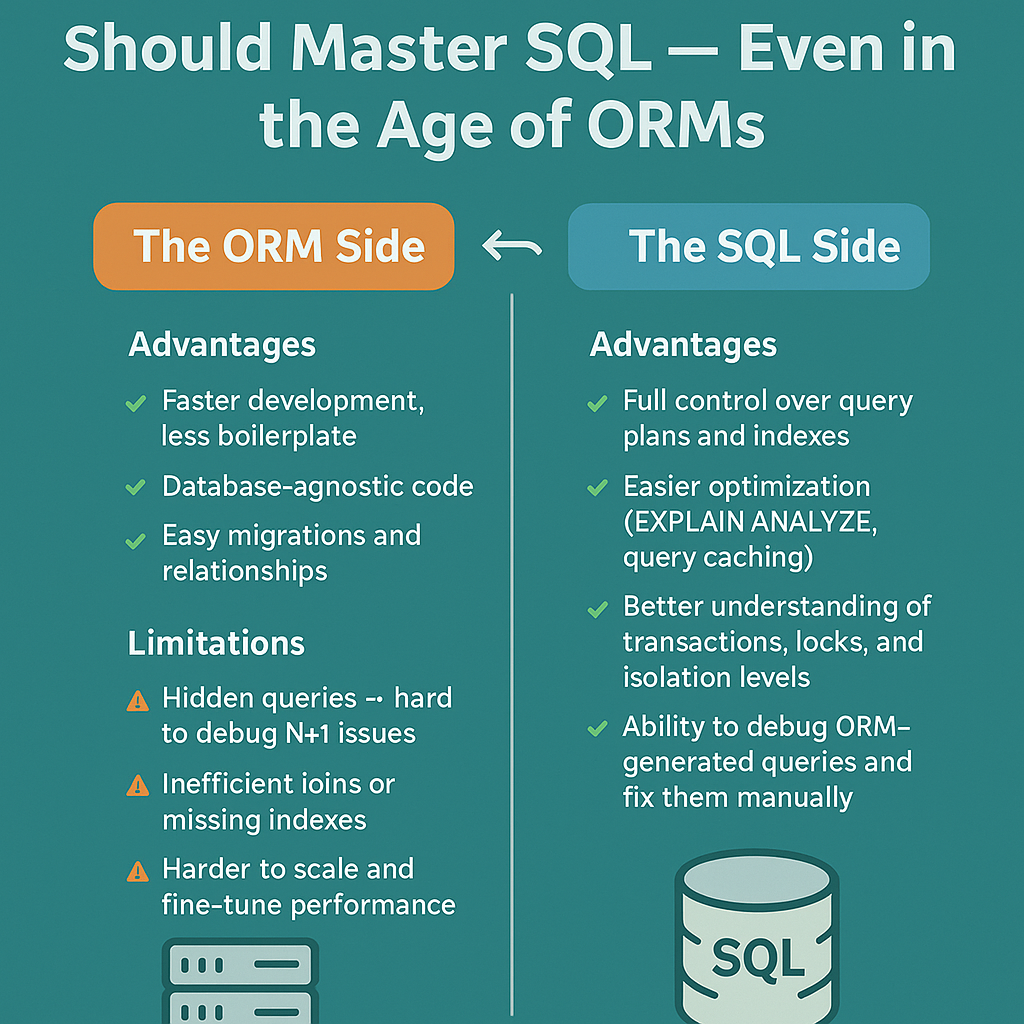
SQL and ORM balance for backend developers

Why Every Backend Developer Should Master SQL — Even in the Age of ORMs

Summary: ORMs make development faster, but mastering SQL and database internals turns good backend engineers into great ones. Here’s why understanding both levels — abstraction and reality — matters. ⚙️ Context & Problem Modern web frameworks — Django, FastAPI, Spring Boot, Laravel — all encourage the use of Object-Relational Mappers (ORMs). They make it easy to map objects to tables, run queries in a few lines of code, and forget about SQL altogether. ...
October 26, 2025 · 5 min · Frederico Gago
Microservices Resilience Cover Image

How to Handle Microservice Failures: The Ambiguous Timeout Dilemma

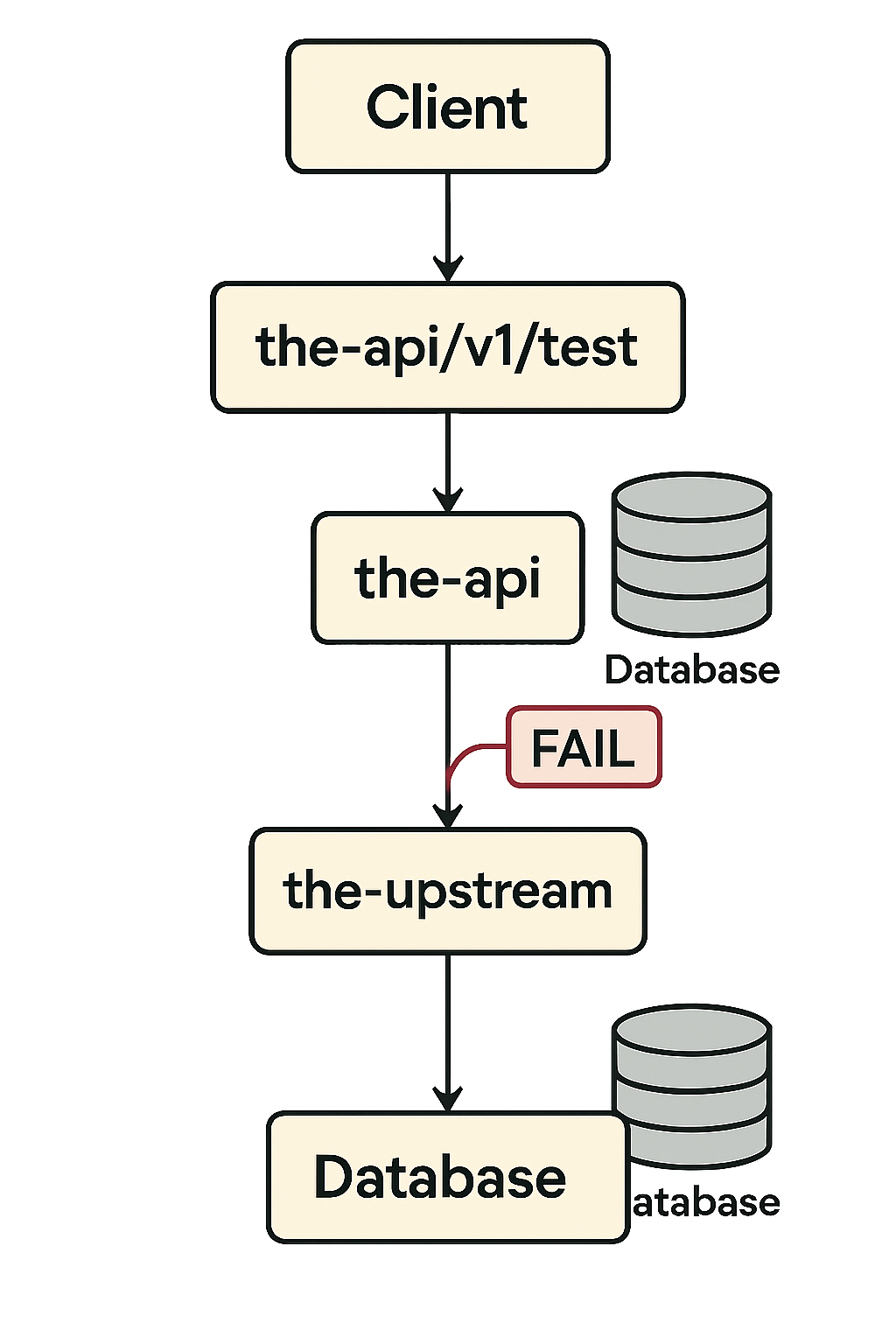
🧩 The Classic Problem: When a Service Doesn’t Respond Imagine the following flow in a service-oriented system: Client → the-api → the-upstream → Database 1️⃣ The client calls the-api/v1/test 2️⃣ the-api calls the-upstream 3️⃣ the-upstream writes data into its own database 4️⃣ It replies OK to the-api 5️⃣ the-api stores the result in its database and replies OK to the client Everything works fine — until step 4 (D) fails because of a network partition or timeout. Now, the-api doesn’t know if the upstream actually wrote the data or not. You can’t safely commit your local write — and you can’t confidently reply to the client. ...

October 6, 2025 · 5 min · Frederico Gago
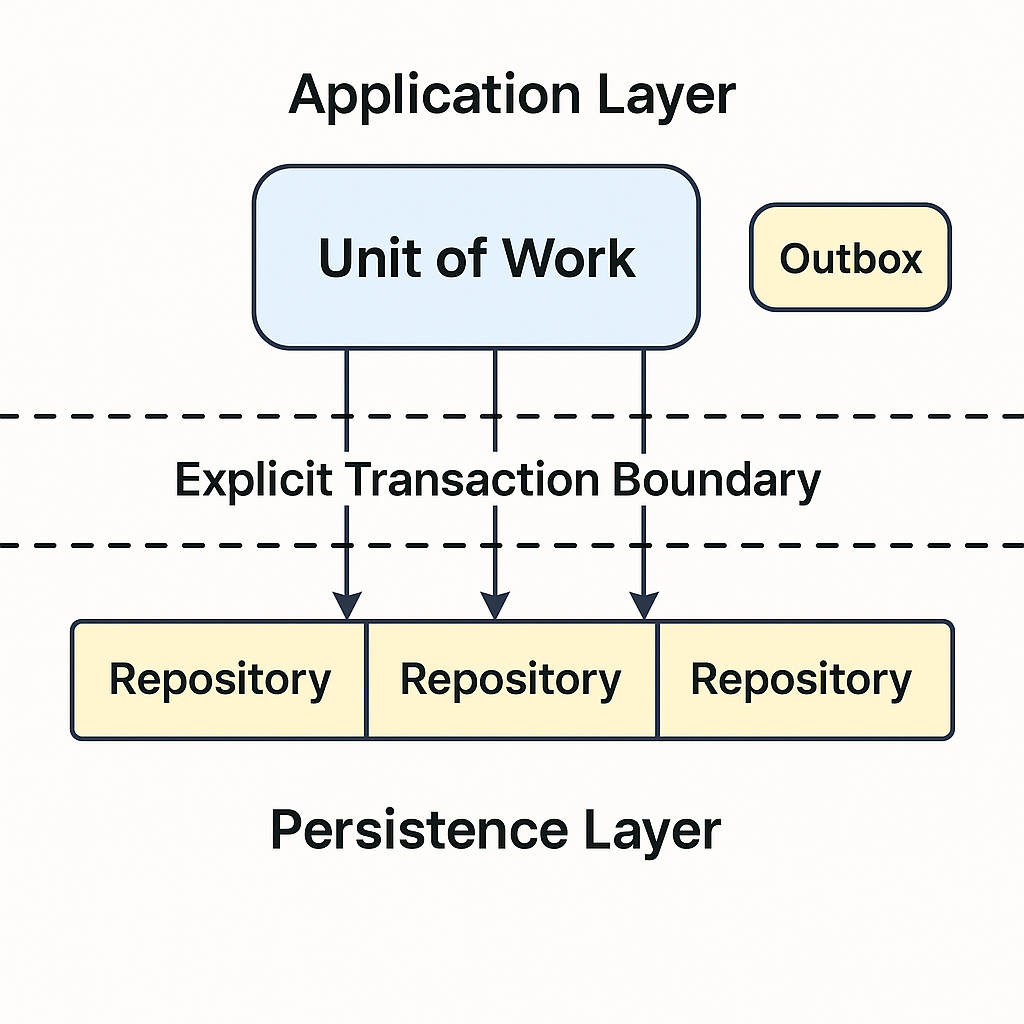
Conceptual diagram of a Unit of Work with application and persistence layers

Unit of Work (UoW) in Python with SQLAlchemy: explicit transactions, savepoints, and outbox

Building a Production-Grade Unit of Work (UoW) System in Python with SQLAlchemy When you build complex applications with databases, services, and background jobs, you eventually run into the transaction problem: How do I guarantee all operations happen atomically? How do I handle nested scopes (reuse vs rollback)? How do I ensure events are only published once? How do I protect against duplicate commits when retries happen? The solution is a Unit of Work (UoW) system — a design pattern that wraps all your persistence operations in a clear, explicit transaction boundary. ...

September 26, 2025 · 5 min · Frederico Gago
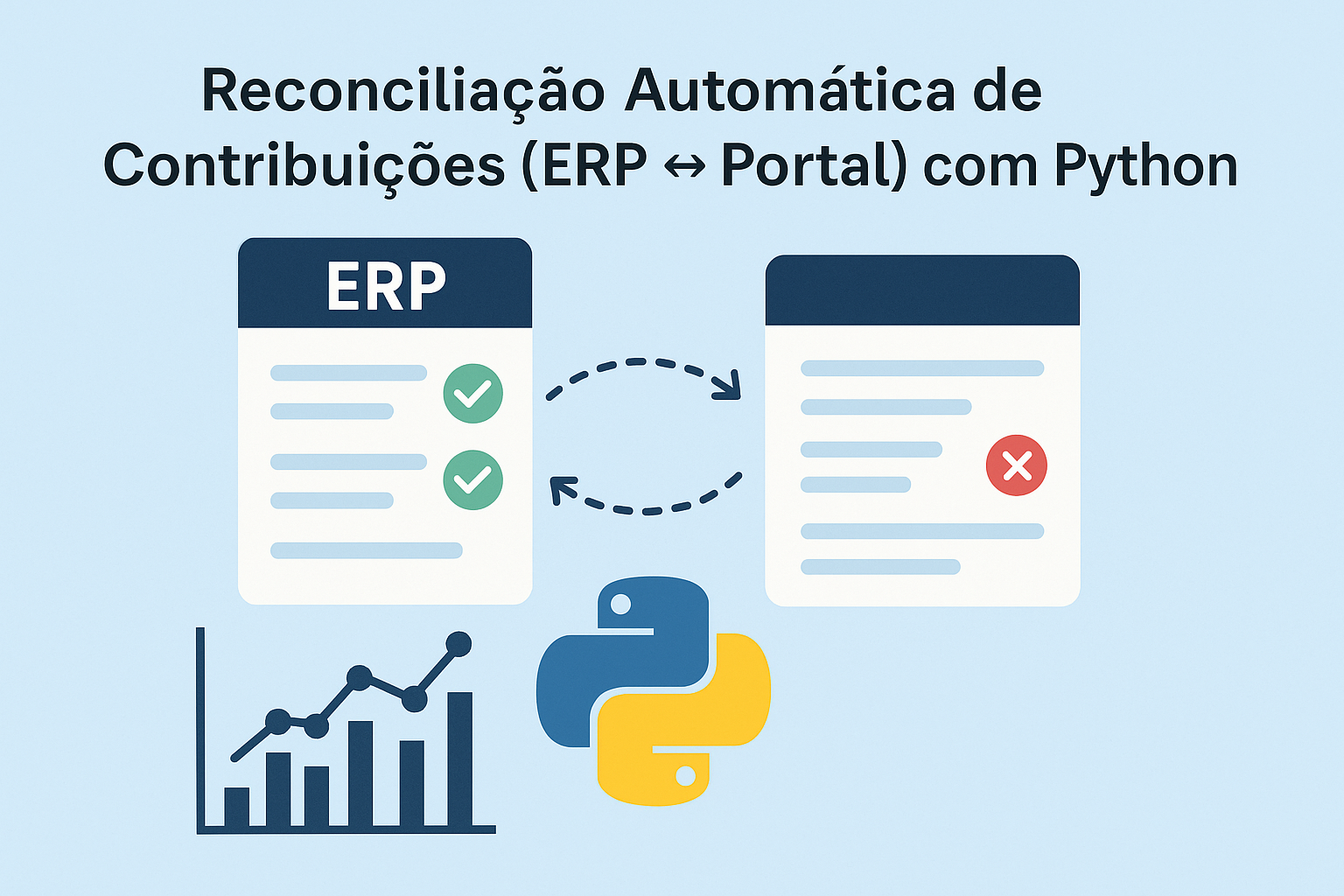
Ilustração de reconciliação de dados

Reconciliação Automática de Contribuições (ERP ↔ Portal) com Python

Resumo: Como automatizei a reconciliação mensal de contribuições entre um ERP e um portal externo. Mostro padrões reutilizáveis: bounded concurrency, retry com backoff + jitter, tolerância monetária, bucketização por período+taxa e upsert idempotente de divergências — usando value objects (YearMonth, Money) e ports (interfaces). Sem expor integrações reais: o foco é a arquitetura e as ideias reutilizáveis. ⚙️ Contexto & Problema Em RH, após o processamento salarial (até dia 10 em PT), é enviado o mapa de contribuições do mês anterior para o portal oficial. Se ocorrerem alterações após o envio (ajustes, faltas, prémios, correções), é fácil esquecer o reenvio do mapa corrigido — gerando inconsistências com risco regulatório e retrabalho. ...

September 11, 2025 · 5 min · Frederico Gago
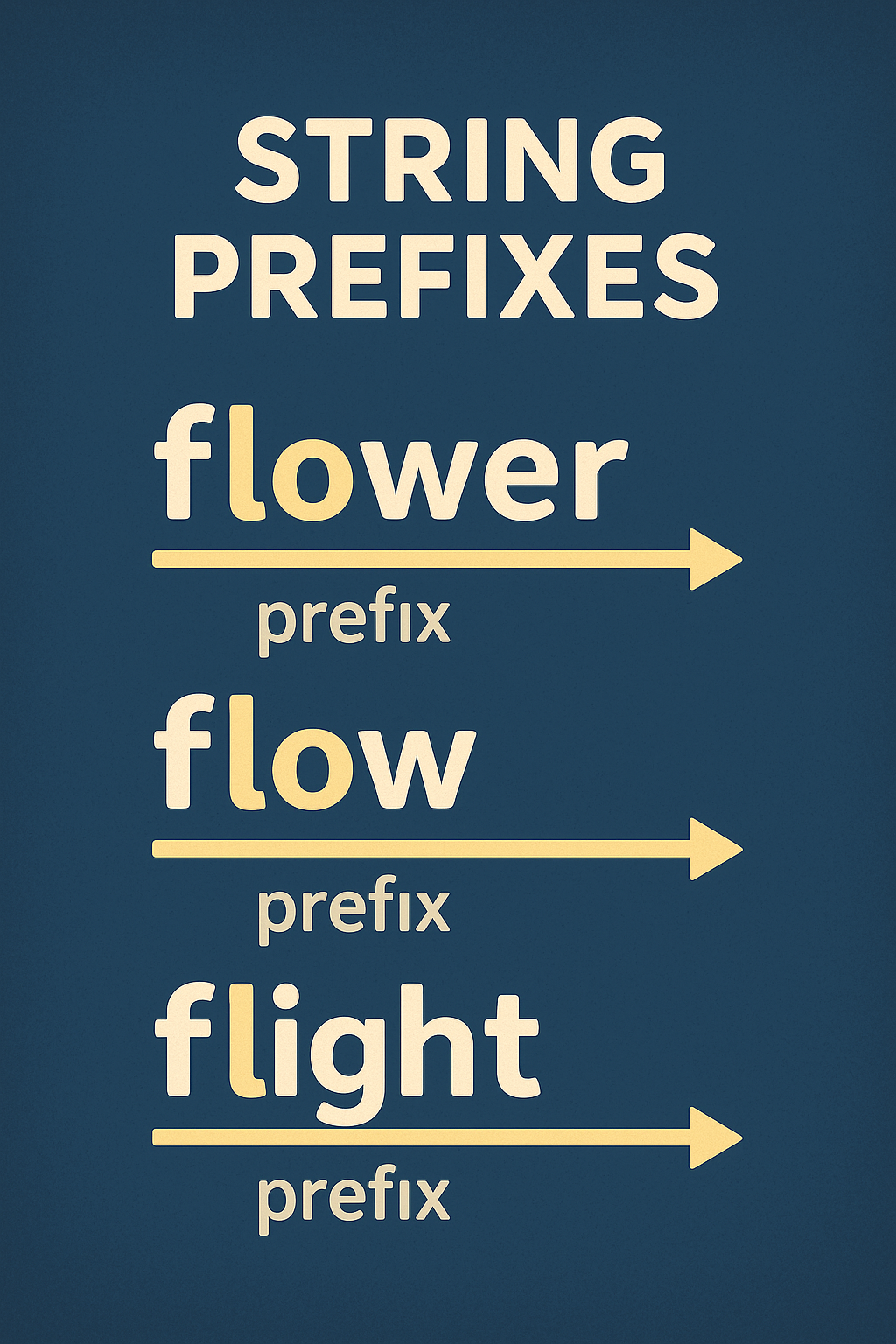
Illustration of string prefixes

Longest Common Prefix: Five Algorithms Compared

🔢 Problem Statement LeetCode 14 – Longest Common Prefix Given an array of strings, return the longest common prefix among them. If no common prefix exists, return an empty string (""). Example 1 Input: ["flower", "flow", "flight"] → Output: "fl" Example 2 Input: ["dog", "racecar", "car"] → Output: "" Constraints 1 ≤ strs.length ≤ 200 0 ≤ strs[i].length ≤ 200 strs[i] contains only lowercase English letters if non-empty. 👨‍💻 Solution Strategies We’ll explore and compare five distinct approaches, from brute force to divide & conquer: ...

August 3, 2025 · 3 min · Frederico Gago
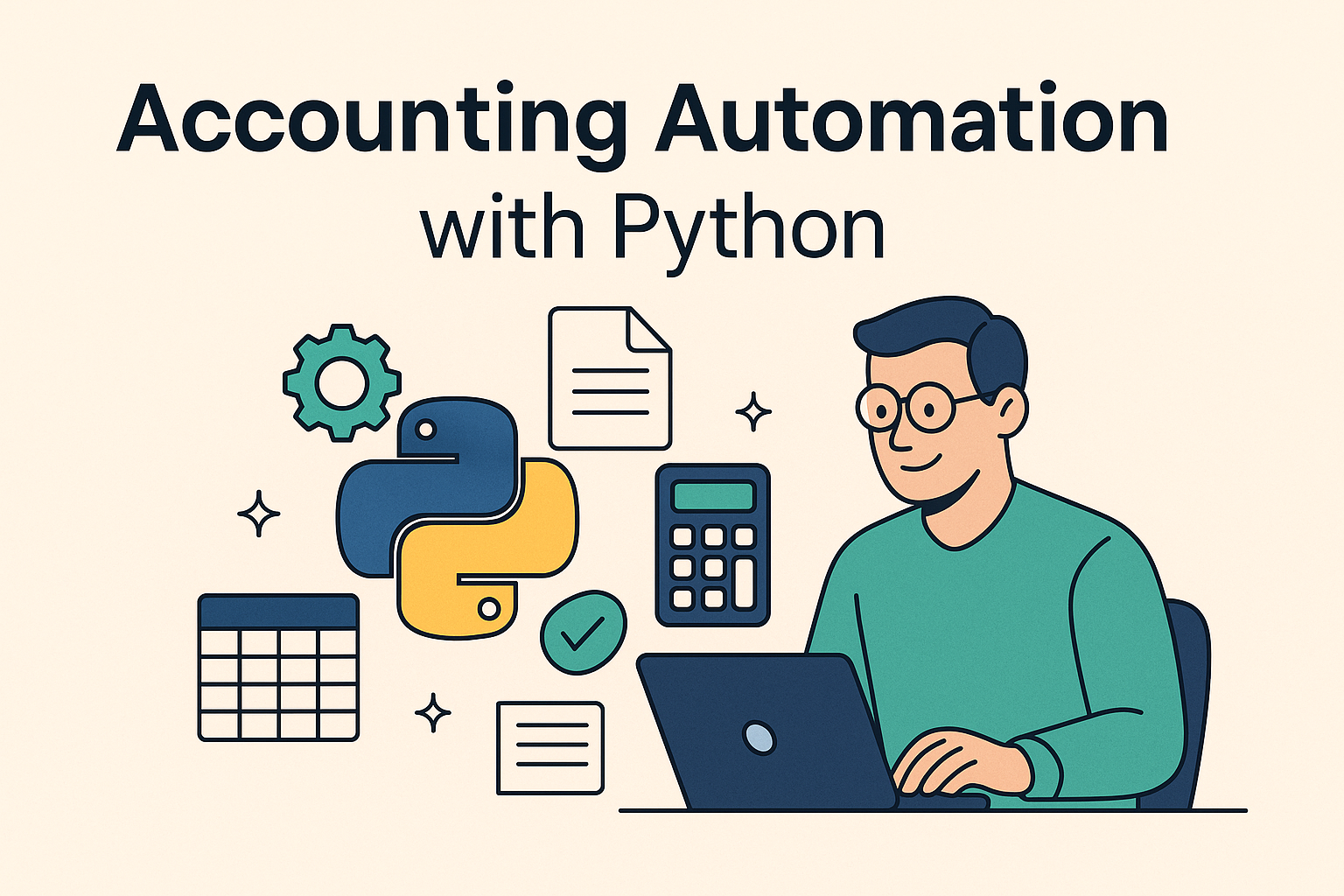
Cover Image

From Spreadsheets to Scripts: My Journey Automating Accounting with Python

From Spreadsheets to Scripts: My Journey Automating Accounting with Python My journey into process automation started at an accounting firm, where I quickly found myself buried in repetitive manual tasks and inefficient workflows. From processing invoices to reconciling spreadsheets, I could see how much time was being lost to work that could — and should — be automated. When I started working there, I spent the first few months organizing paperwork and doing basic data entry. I quickly realized two things: ...

July 27, 2025 · 4 min · Frederico Gago
Python Code Cover Image

Roman to Integer — Clean, Fast, and Functional Approaches Compared

🧩 Problem: Roman to Integer (LeetCode 13) Convert a string representing a Roman numeral into its integer value. Roman numerals are typically written from largest to smallest (left to right), except for six well-known subtractive cases: I before V or X → 4, 9 X before L or C → 40, 90 C before D or M → 400, 900 ✅ Clean Idiomatic Solution (One-Pass) class Solution: SYMBOLS = { 'I': 1, 'V': 5, 'X': 10, 'L': 50, 'C': 100, 'D': 500, 'M': 1000 } def romanToInt(self, s: str) -> int: total = 0 prev_value = 0 for c in s: value = self.SYMBOLS[c] total += value - 2 * prev_value if value > prev_value else value prev_value = value return total Single loop Detects subtractive patterns with value > prev_value Clean inline logic ✅ Runtime: 3 ms (faster than 79.17%) ✅ Memory: 17.6 MB (less than 90.19%) ...

July 20, 2025 · 3 min · Frederico Gago
Python Code Cover Image

Is It a Palindrome Number? Three Ways to Solve It Without Converting to String

🧩 The Problem Given an integer x, determine whether it’s a palindrome — that is, whether it reads the same forwards and backwards. 🔗 Problem Link: LeetCode 9. Palindrome Number Examples Input: x = 121 → Output: True Input: x = -121 → Output: False Input: x = 10 → Output: False Bonus: Can you solve it without converting the integer to a string? 🔍 The Three Approaches I Explored 1. 💡 Direct Solution with String Conversion def isPalindrome(x: int) -> bool: return str(x) == str(x)[::-1] Simple and fast (4 ms on LeetCode) But does not satisfy the follow-up constraint of avoiding strings 2. 📐 Mathematical Reversal Using log10 and Closed-Form Formula Inspired by this StackExchange post, this solution uses a formula to reverse digits without strings: ...

July 6, 2025 · 2 min · Frederico Gago