Summary
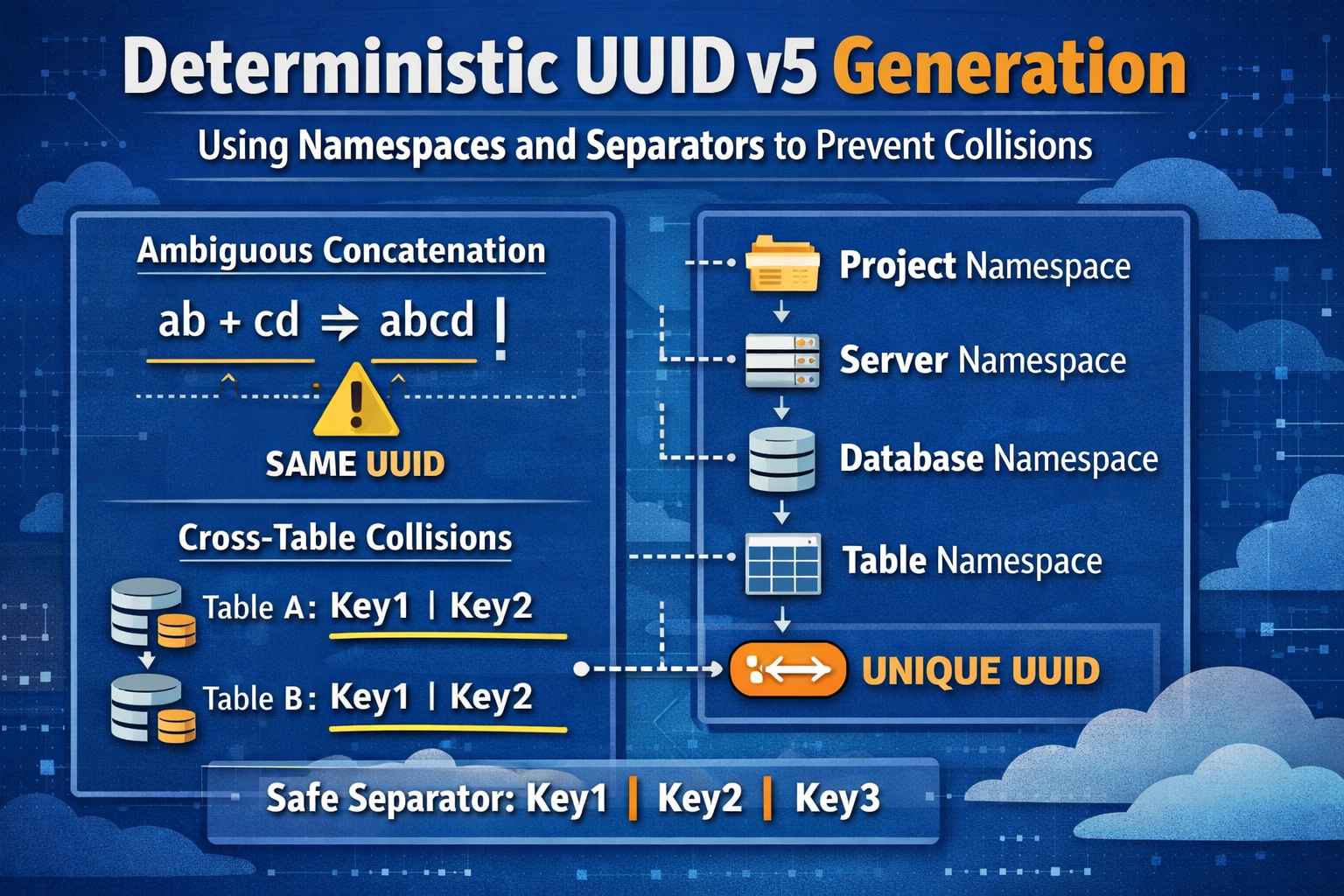
I was generating deterministic UUID v5 primary keys from business keys. It worked well—until subtle but serious collision risks appeared:
- Ambiguous concatenation (
ab + cdvsa + bcd)- Cross-table collisions (different tables, same business values → same UUID)
This post presents a clean, modular solution using explicit separators and namespace scoping, and explores the harder problem of multi-source ingestion.
⚙️ Context & Problem
In data platforms and ETL systems, business keys are often the only stable identifiers available (for example, composite natural keys).
To ensure idempotency and simplify upserts and deduplication, a common pattern is:
- generate a deterministic UUID (UUID v5) from business keys;
- use that UUID as the primary key.
This approach has clear advantages:
- same input → same ID;
- safe reprocessing;
- simpler merges and comparisons.
However, determinism introduces its own risks.
❌ Problem 1 — Concatenation ambiguity
If business values are concatenated without boundaries:
("ab", "cd")→"abcd"("a", "bcd")→"abcd"
UUID v5 hashes the final string together with the namespace, so both cases produce the same UUID.
This is a silent data bug: no constraint violation, no error—just incorrect identity.
❌ Problem 2 — Collisions across tables
Even with safe concatenation, consider two different tables:
table_a(col1, col2)table_b(col1, col2)
If both contain the same business values, a deterministic UUID generated from those values will be identical—even though the entities belong to different domains.
This can lead to:
- incorrect joins in downstream pipelines;
- unintended overwrites during merges;
- subtle corruption in consolidated datasets.
🎯 Goal
Design a clean, deterministic, and scalable UUID generation strategy that:
- avoids concatenation ambiguity;
- prevents cross-table collisions;
- does not depend on storing random “seed UUIDs”;
- remains suitable for ETL and distributed systems.
🧱 Technical Approach
Guiding principles
- Explicit boundaries between values → always use a separator.
- Domain-aware determinism → UUIDs must be scoped to their domain.
- Single responsibility → one function generates identifiers.
- No hidden state → deterministic, explainable behavior.
1️⃣ Explicit separator (mandatory)
Instead of:
ab + cd → abcd
Use:
ab | cd
Now:
ab | cd ≠ a | bcd
The separator must be either:
- guaranteed not to appear in the data, or
- consistently escaped/normalized.
2️⃣ Namespace scoping
UUID v5 is computed as:
UUID = v5(namespace_uuid, name)
If the namespace is too broad, determinism becomes dangerous.
A practical solution is to scope namespaces hierarchically, for example:
- stable root namespace
- project
- database server / cluster
- database
- table
Each level derives a new namespace from the previous one.
This guarantees:
- the same business key in different tables produces different UUIDs
- consistent behavior across environments.
⚠️ Why not store a random namespace UUID in the database?
Because if that value is changed or lost:
- all deterministic IDs change;
- primary and foreign keys break;
- historical data becomes inconsistent.
That is operationally unsafe.
🧩 Practical PostgreSQL Implementation
Enable UUID support
CREATE EXTENSION IF NOT EXISTS "uuid-ossp";
Helper: build a safe name string
This function:
- trims values;
- replaces
NULLwith a sentinel; - enforces a separator.
CREATE OR REPLACE FUNCTION build_uuid_name(
    values text[],
    sep text DEFAULT '|',
    null_token text DEFAULT '<NULL>'
) RETURNS text
IMMUTABLE
LANGUAGE sql
AS $$
SELECT array_to_string(
         ARRAY(
           SELECT COALESCE(NULLIF(btrim(v), ''), null_token)
           FROM unnest(values) AS v
         ),
         sep
       );
$$;
Main function: deterministic UUID v5 primary key
This version uses a stable root namespace (uuid_ns_dns()) and nests namespace derivation without intermediate queries.
CREATE OR REPLACE FUNCTION uuid_v5_business_pk(
    project_name text,
    db_server text,
    db_name text,
    table_name text,
    business_values text[],
    sep text DEFAULT '|'
) RETURNS uuid
IMMUTABLE
LANGUAGE sql
AS $$
SELECT uuid_generate_v5(
         uuid_generate_v5(
           uuid_generate_v5(
             uuid_generate_v5(
               uuid_generate_v5(
                 uuid_ns_dns(),
                 project_name
               ),
               db_server
             ),
             db_name
           ),
           table_name
         ),
         build_uuid_name(business_values, sep)
       );
$$;
🗂️ Optional: Namespace Registry Table (governed determinism)
String-derived namespaces are deterministic, but fragile: names can be reused, renamed, or drift over time.
A namespace registry table introduces a governed root namespace per logical domain, decoupling identifier stability from infrastructure naming.
A domain can represent:
- a logical dataset (
dataset_x_v1); - a canonical entity (
entity_y); - a producer–entity boundary (
source_a:entity_z).
Why this helps
- Stability across renames
- Explicit ownership and governance
- Multi-source collision isolation, without adding a
sourcecolumn to the final table
Trade-offs
- Namespace UUIDs must be immutable once used
- ID generation now depends on registry availability (usually acceptable)
Registry table (minimal design)
CREATE TABLE IF NOT EXISTS uuid_namespace_registry (
    namespace_key   text PRIMARY KEY,
    namespace_uuid  uuid NOT NULL UNIQUE,
    description     text,
    created_at      timestamptz NOT NULL DEFAULT now(),
    created_by      text
);
Registered UUID generation function
CREATE OR REPLACE FUNCTION uuid_v5_business_pk_registered(
    p_namespace_key text,
    p_business_values text[],
    p_sep text DEFAULT '|'
) RETURNS uuid
STABLE
LANGUAGE plpgsql
AS $$
DECLARE
    v_namespace uuid;
BEGIN
    SELECT r.namespace_uuid
      INTO v_namespace
      FROM uuid_namespace_registry r
     WHERE r.namespace_key = p_namespace_key;

    IF NOT FOUND THEN
        RAISE EXCEPTION
            'Namespace not registered for namespace_key=%',
            p_namespace_key
            USING ERRCODE = '22023';
    END IF;

    RETURN uuid_generate_v5(
        v_namespace,
        build_uuid_name(p_business_values, p_sep)
    );
END;
$$;
🧠 The harder case: multi-source ingestion
Everything above works as long as identity has a single authority.
The real complexity appears when a single target table ingests data from multiple independent sources, each producing deterministic UUIDs from business keys.
At that point, determinism alone becomes a liability.
The core issue
Different sources may:
- use identical business values,
- apply the same UUID logic,
- and generate the same UUID,
even though the records:
- originate from different systems,
- carry different trust levels,
- or represent slightly different semantics.
These collisions are silent—and extremely dangerous.
The constraint is intentional:
The final table represents a canonical view, not a staging area. Adding a
sourcecolumn is not desired.
Possible strategies (none are perfect)
Option A — Include the source in the namespace
Each source gets its own namespace.
Pros
- Collision-proof
- Fully deterministic
- No runtime coordination
Cons
- Same real-world entity → different UUIDs
- Requires later entity resolution
Option B — Surrogate internal ID + natural key
The target system owns identity.
Pros
- PK stability
- Clear ownership
- No producer collisions
Cons
- Harder idempotency
- Requires matching logic
Option C — Central ID registry / resolver
A canonical identity service.
Pros
- Strong consistency
- One UUID per real-world entity
Cons
- Operational complexity
- Runtime coupling
- Throughput and availability concerns
Where this stands
Avoiding a source column while preserving:
- deterministic behavior,
- collision safety,
- long-term maintainability,
is a non-trivial design problem.
This part of the system is intentionally open for discussion.
If you’ve solved this differently in a multi-source data platform, I’d genuinely like to compare approaches.
💬 Final Thoughts
UUID v5 is powerful—but only if:
- concatenation is explicit and unambiguous;
- determinism is scoped to the correct domain.
Otherwise, collisions will eventually happen—quietly and painfully.
- LinkedIn → https://www.linkedin.com/in/frederico-gago-5849281aa
- GitHub → https://github.com/fredericogago