Building a Production-Grade Unit of Work (UoW) System in Python with SQLAlchemy
When you build complex applications with databases, services, and background jobs, you eventually run into the transaction problem:
- How do I guarantee all operations happen atomically?
- How do I handle nested scopes (reuse vs rollback)?
- How do I ensure events are only published once?
- How do I protect against duplicate commits when retries happen?
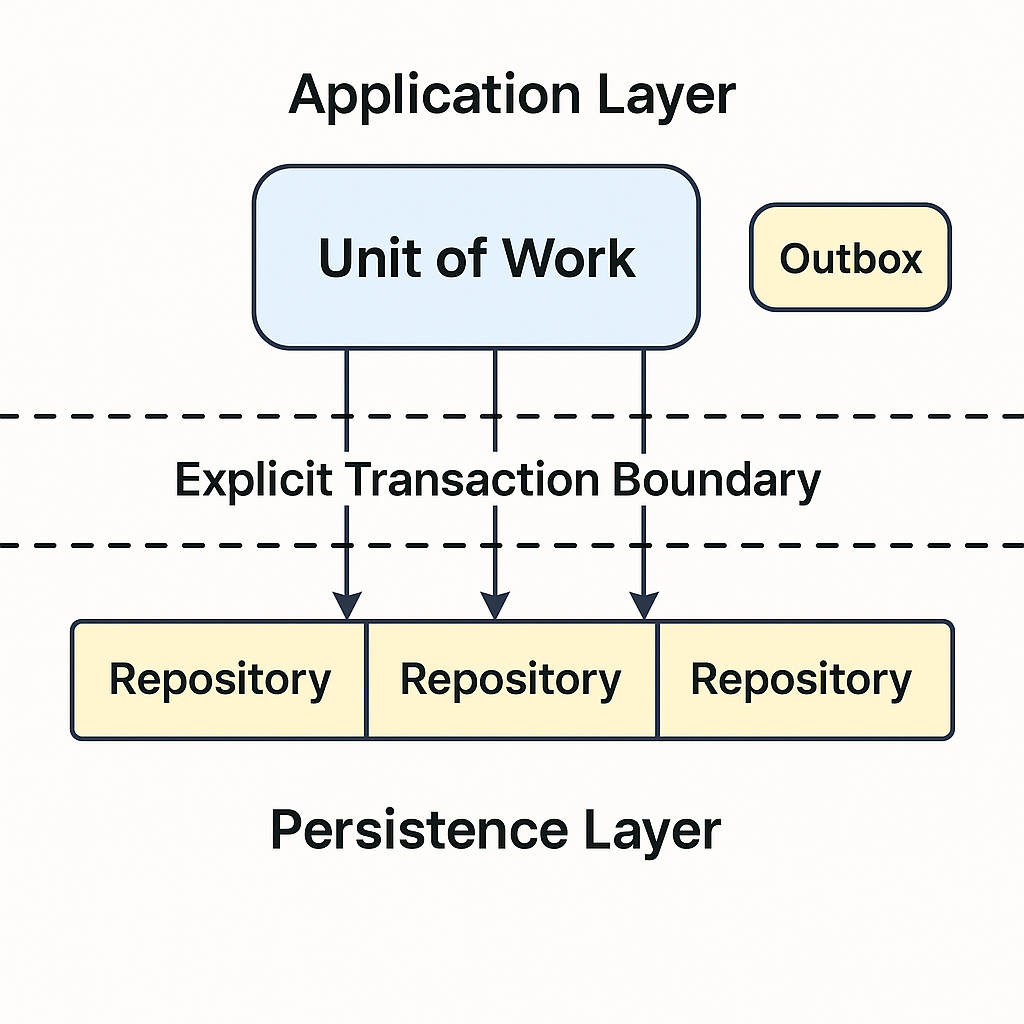
The solution is a Unit of Work (UoW) system — a design pattern that wraps all your persistence operations in a clear, explicit transaction boundary.
In this post, I’ll show you how I built a production-grade UoW system in Python 3.13 using async SQLAlchemy, with:
- Explicit transaction boundaries
- Safe nesting (reuse vs savepoint)
- Read-only transactions
- Transactional outbox for events
- Idempotency key protection
- Great testing story
🚨 The Problem: Repos Without Boundaries
A naive service might look like this:
user = await user_repo.create(User(...))
order = await order_repo.create(Order(...))
await email_service.send_order_confirmation(order)
But what if the order commit fails while the email has already been sent? You’ve just created an inconsistent state.
Without a transaction boundary, repositories can be called arbitrarily, leading to partial failures and ghost side effects.
✅ The Solution: Unit of Work + Manager
The UoW system enforces a strict rule:
👉 All repos must be accessed through a UoW scope.
A service now looks like this:
async with uow_manager.enter(mode=UoWMode.REUSE) as uow:
    user = await uow.repos.user.create(User(...))
    order = await uow.repos.order.create(Order(...))
    uow.add_event("order.created", {"order_id": order.id})
At the end of the scope:
- If everything succeeded → commit.
- If something failed → rollback.
- Events are persisted only on outermost commit.
🧑💻 The Code
SqlAlchemyUoWBase
This is the core UoW implementation. It wraps an AsyncSession, tracks events and idempotency keys, and handles nesting rules.
class SqlAlchemyUoWBase[IRepos](IUnitOfWork[IRepos]):
    """Unit-of-Work facade with nesting support (reuse vs savepoint)."""

    def __init__(
        self,
        session: AsyncSession,
        level: int,
        *,
        read_only: bool = False,
        event_sink: EventSink,
        idem_box: IdemBox,
    ) -> None:
        self._s = session
        self._level = level
        self._read_only = read_only
        self._active = True
        self._tx = None
        self._events = event_sink
        self._idem_box = idem_box
        self._repos: IRepos | None = None

    ...
UoWManager
The manager ensures that:
- Sessions are reused across nested scopes
- Events/idempotency are shared at all levels
- Commit/rollback/close are coordinated correctly
class UoWManager[UowBaseT, IRepos](IUoWManager):
    """Creates UoW scopes over a shared AsyncSession with nesting support."""

    @asynccontextmanager
    async def enter(self, *, mode: UoWMode = UoWMode.REUSE, read_only: bool = False):
        mark_enter(self._label)
        try:
            if self._session is None:
                self._session = self._sf()
                self._event_sink = EventSink(items=[])
                self._idem_box = IdemBox()

            level = len(self._stack) + 1
            nested = level > 1 and mode is UoWMode.SAVEPOINT
            start_tx = (level == 1) or nested

            uow = self._uow_cls(
                self._session, level,
                read_only=read_only,
                event_sink=self._event_sink,
                idem_box=self._idem_box,
            )
            uow.set_repos(self._repo_factory(self._session))
            self._stack.append(uow)

            await uow.start(start_tx=start_tx)
            try:
                yield uow
                await uow.commit(started_tx=start_tx)
            except Exception:
                await uow.rollback(started_tx=start_tx)
                raise
            finally:
                self._stack.pop()
                if not self._stack:
                    await self._session.close()
                    self._session = None
                    self._event_sink = None
                    self._idem_box = None
        finally:
            mark_exit(self._label)
🔄 Visual Flow
Outermost Transaction (Level 1)
BEGIN TRANSACTION
  ... repo operations ...
COMMIT
→ Flush outbox
→ Persist idempotency key
Nested Reuse (Level > 1, REUSE)
(no BEGIN, reuse outer tx)
  ... repo operations ...
(no COMMIT, outer decides)
Nested Savepoint (Level > 1, SAVEPOINT)
BEGIN NESTED (savepoint)
  ... repo operations ...
RELEASE SAVEPOINT
📦 Events + Idempotency
Both inner and outer scopes share the same sinks:
EventSink→ events are buffered and only persisted to the outbox table on the outermost commitIdemBox→ idempotency key ensures retries don’t double-commit
uow.add_event("user.created", {"id": 123})
uow.set_idempotency_key("req-uuid")

# Outer commit persists:
# - Outbox row
# - Idempotency key row
📊 Quick Comparison
| Mode | Behavior | Use Case |
|---|---|---|
| OUTERMOST | Starts real transaction, commits, flushes events | Normal service call |
| REUSE | Shares outer transaction, no BEGIN/COMMIT | Helpers that must be atomic with parent |
| SAVEPOINT | Creates nested savepoint, rollback safe | Risky operations (e.g., optional steps) |
🧪 Testing with Fake UoWManager
One of the biggest benefits of this design is that you can easily fake the UoW in tests.
Instead of creating a real SQLAlchemy session, you inject in-memory repositories.
Fake Manager Example
class FakeConfigRepo(IConfigRepo):
    def __init__(self):
        self.items = []

    async def get_configurations_by_group_name(self, group_name):
        return [i for i in self.items if i.group == group_name]


class FakeRepos(IConfigRepos):
    def __init__(self):
        self._config = FakeConfigRepo()

    @property
    def config(self) -> IConfigRepo:
        return self._config


class FakeUoW(IUnitOfWork[FakeRepos]):
    def __init__(self):
        self._repos = FakeRepos()
        self._active = True

    @property
    def repos(self) -> FakeRepos:
        return self._repos

    async def commit(self, *, started_tx: bool) -> None: ...
    async def rollback(self, *, started_tx: bool) -> None: ...
    async def close(self) -> None: ...
    def add_event(self, *, event_type: str, payload: dict) -> None: ...
    def set_idempotency_key(self, key: str | None) -> None: ...
    @property
    def level(self) -> int: return 1
    @property
    def is_active(self) -> bool: return self._active


class FakeUoWManager(IUoWManager):
    async def enter(self, *, mode=UoWMode.REUSE, read_only=False):
        uow = FakeUoW()
        yield uow
Example Test
async def test_get_configs_returns_items():
    mgr = FakeUoWManager()
    async with mgr.enter() as uow:
        uow.repos.config.items.append(ConfigItem(group="general", key="x", value="1"))

        service = ConfigService(uow.repos.config)
        result = await service.get_configurations_by_group_name("general")

        assert result.is_ok()
        assert len(result.unwrap()) == 1
This way:
- No database required
- No transactions opened
- Service logic is testable in isolation
⚡ Performance Notes
One subtle advantage of this design is control over transaction cost.
-
REUSEmode is the fastest:- No new transaction, no savepoint, no roundtrips.
- Best when nested operations are always safe to run under the parent scope.
-
SAVEPOINTmode adds overhead:- Each savepoint requires SQL roundtrips (
SAVEPOINT,ROLLBACK TO,RELEASE). - Use it when you need to isolate risky steps without aborting the entire parent transaction.
- Each savepoint requires SQL roundtrips (
Example rule of thumb:
- Use
REUSEfor 95% of nested calls (normal service-to-service collaboration). - Use
SAVEPOINTsparingly (e.g., optional third-party calls, best-effort cleanups).
This balance keeps transactions fast, predictable, and resilient.
🏁 Closing Thoughts
The Unit of Work pattern is not just a persistence abstraction. It’s a contract:
- Every service runs inside a transaction.
- Events are only published if the transaction commits.
- Duplicate commits are prevented with idempotency.
With this system, my services are safer, my tests are easier, and my architecture is cleaner.
In asynchronous apps built with SQLAlchemy + FastAPI, a combination of UoW Manager + UoW Base delivers safety, testability, and a clean architecture.
💬 Do you prefer implicit context (via contextvars) or explicit scopes like this? Share your thoughts!